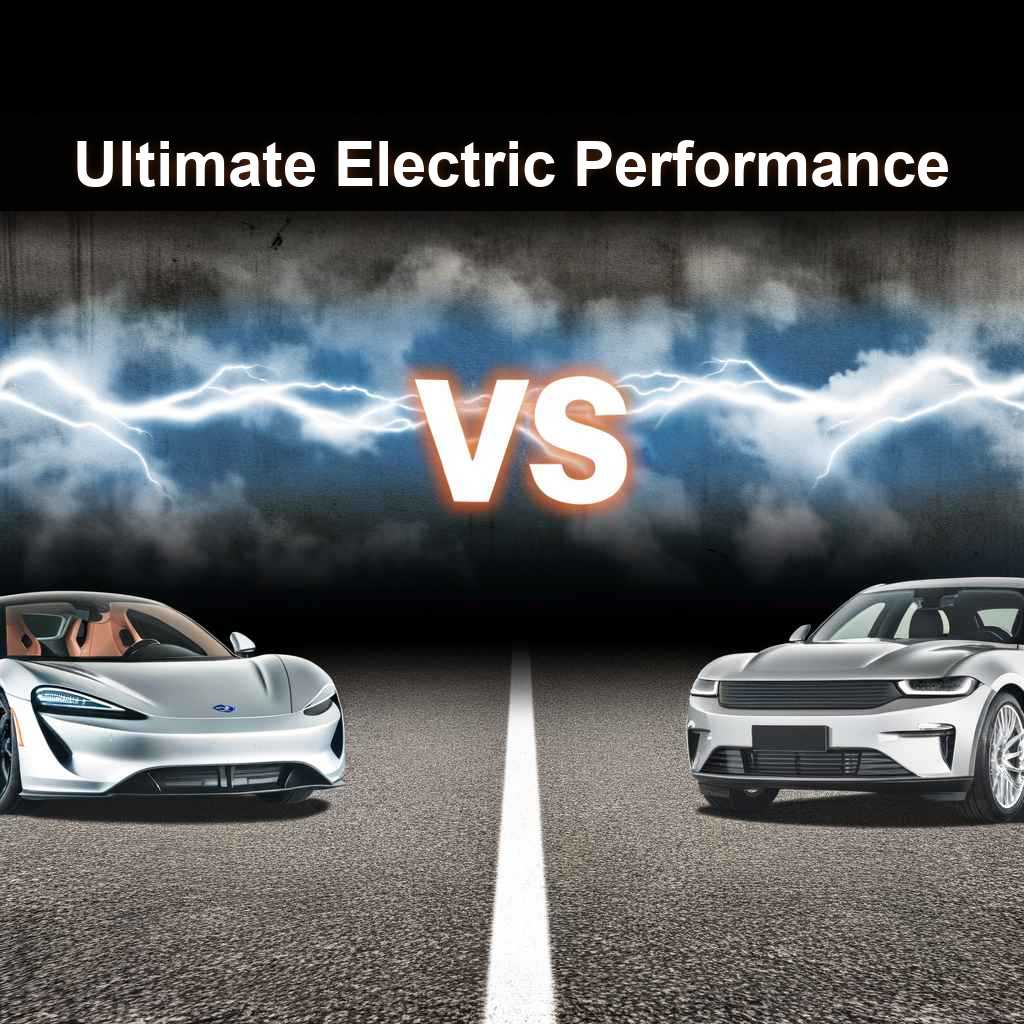
Electric performance has evolved from a niche experiment into a full-blown arms race, and nowhere is that clearer than in the showdown between the Porsche Taycan Turbo S and the Tesla Model S Plaid. These are two radically different interpretations of the same brief: deliver instant, repeatable, world-class performance without a drop of fuel.
Power and acceleration
The Tesla Model S Plaid produces a staggering 1,020 horsepower from its tri-motor setup, routing power through a torque-vectoring rear and a single front motor. Tesla's claimed 0–60 mph time of 1.99 seconds (with rollout) is backed up on prepped surfaces, and the Plaid continues to pull hard well past 150 mph.
The Taycan Turbo S counters with 750 hp (with launch control) through a two-speed rear transmission, which gives it a mechanical advantage above 70 mph that most EVs can't match. In roll-on acceleration, the two cars are closer than the spec sheet suggests — and in the corners, the Porsche opens a very different kind of gap.
Chassis and feel
This is where the Taycan asserts its identity. Three-chamber air suspension, rear-wheel steering, and a torque-vectoring Plus differential make the Taycan feel like it was carved by hand on the Nordschleife. The steering is dense and feelsome in a way most EVs aren't, and body control stays flat even under heavy trail-braking.
The Model S Plaid, by contrast, feels relentless rather than communicative. Grip is excellent, body roll is minimal, and the yoke-style steering (where fitted) is polarizing. On a canyon road the Plaid is quick, but the Taycan is engaging.
Interior and tech
Porsche's cabin is a modern reinterpretation of the 911 playbook — a driver-focused layout, a configurable digital instrument cluster, and genuinely good materials end-to-end. Tesla's cabin is minimalist to a fault; the 17-inch landscape display is impressive but puts almost every function one tap deep inside a UI.
Range and charging
The Model S Plaid holds a clear range advantage on paper (around 348 miles EPA) versus the Taycan Turbo S (around 222 miles EPA). But Porsche's 800-volt architecture allows the Taycan to peak at well over 250 kW on compatible chargers, meaning a 10–80% top-up often takes under 25 minutes. In many real-world road trips the gap narrows significantly.
Verdict
If outright drag-strip performance and long range are the priority, the Tesla Model S Plaid is impossible to ignore. But if you want an EV that still feels like a driver's car — one that rewards inputs, carves a corner and talks back through the steering wheel — the Porsche Taycan Turbo S remains the benchmark. Different missions, different answers; both are the sharpest edge of what electric performance looks like today.